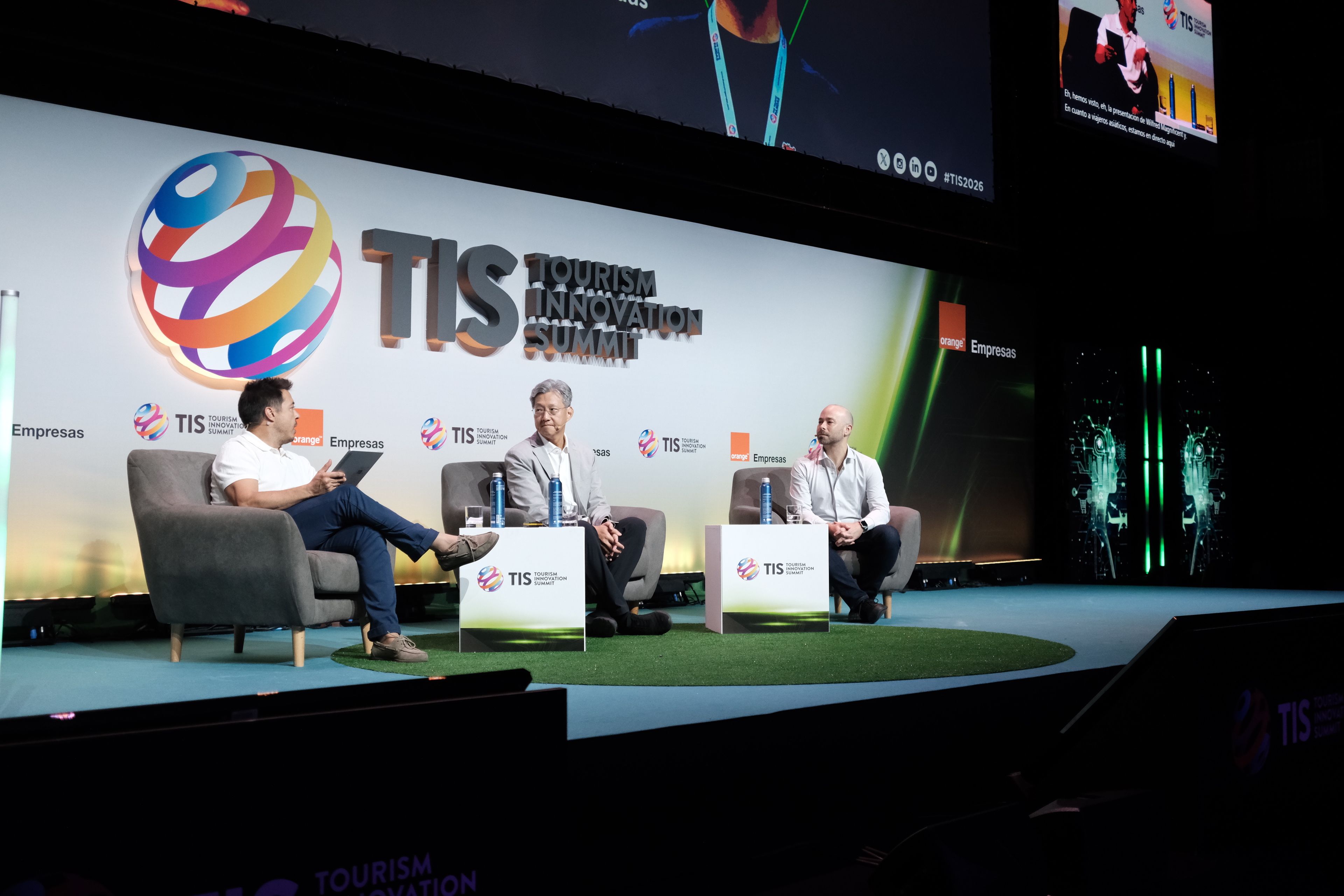
In early October I spent two days at the Tourism Innovation Summit (TIS) in Seville, Spain. Hotel groups, OTAs, Google, Tripadvisor, tourism boards and EU policy makers were all under one roof, talking about where travel is heading and hosting intimate panel discussions.
Three themes came up in almost every session:
Guests are asking AI where to stay, and many properties don't show up.
Trust is becoming the thing that wins the booking.
As AI spreads, the people behind a stay matter even more.
For each one you'll find what the speakers said, how we're responding at Springnest, and what you can do yourself this month.
Guests are asking AI where to stay
I feel like this is general knowledge by now, but it was definitely validated at TIS: an increasing percentage of travellers now ask an AI assistant to recommend a place, instead of scrolling through search results. If the AI can't read and understand your property, you're simply left out of the answer.
What we heard
Radisson found it was invisible. Raúl Álvarez Barrera, who leads digital at Radisson, said their search traffic fell by about 20% before they realised AI tools weren't recommending their hotels at all in some destinations. They rebuilt their entire content strategy and the way their pages are created on their site, from the ground up, and traffic is growing again (imagine how expensive that must have been for a brand with over 1500 hotels...)
Small properties can win here. Raúl's most hopeful point (for smaller properties): a well-prepared hotel outside the city centre can appear first, ahead of the big chains, if those chains haven't done the work. Being "big" is no longer enough.
Three ingredients. He said AI tools look for reputation (reviews and mentions elsewhere), content that answers real guest questions (his example was "what are the vegan breakfast options?"), and a website that is easy for AI to read.
Better, not more. Celia Díaz Segovia, Communications Manager for VisitBritain, put it simply: "We don't need to create more content, we need to create better content." Search shows what's available. AI shows what's right for this particular guest.
Keep it in proportion. Raúl estimated AI tools bring only around 5% of bookings today. Another panel predicted AI booking assistants will bring at least 20% of new customers by the end of 2027. Small now, growing fast.
You can choose how AI tools are allowed to use your content, in the new AI Visibility tab in Springnest Settings.
With FAQ pages, you can create simple, factual information about your property in a format that AI agents can understand and contextualise.
We're focusing our next work on helping you answer the questions guests actually ask, in plain language on your own site.
What you can do this month
Try the AI self-test. This one comes from Alba Rueda of Cometa Web, who shared it on stage. Ask an AI assistant (such as ChatGPT or Gemini) the way a guest would, without your name. For example: "Quiet place to stay near the beach in [your town] for a couple, what do you recommend?" Then check: do you appear, how are you described, who is recommended instead, and which websites does it quote?
Ask yourself Alba's hard question. Does your own website explain your property better than your Booking.com listing does? If not, that's where to start.
Add a few real answers. Write short answers to the questions guests email you about most: parking, breakfast times, dietary options, how far the beach is. A simple FAQ page is perfect.
Check you're consistent. Your name, address, room types and facilities should match on your website, Google Business Profile and booking listings.
2. Trust is what wins the booking
When anyone can produce content in seconds, guests and AI tools both look harder at what they can trust. Reviews, honest prices and good service are moving from important to essential.
What we heard
Unanswered reviews are the real problem. Jesús Menéndez, President of the Asociación Española de Hoteles, said most of Spain's 18,000 hotels are independents, many with fewer than 25 rooms, and that "you have a lot of reviews and nobody answers." The reasons he gave ranged from capacity to the digital proficiency of small independent accommodation owners.
Negative is not the same as fake. Fabrizio Orlando, Director at Tripadvisor, said: "We need to make a distinction between fake review and negative review." Tripadvisor removed 2.7 million reviews last year, and owners can flag reviews that break the rules.
Video reviews are arriving. Tripadvisor has started accepting video reviews, and younger travellers increasingly trust short videos over written reviews.
AI booking assistants will expose tricks. On a panel about AI agents, speakers agreed these tools will always hunt for the cheapest genuine rate. Fuzzy discounts and pricing tricks will be found out quickly. Honest prices and real perks will stand out.
Real loyalty comes from care. The same panel said loyalty is built when something goes wrong on a trip and the provider fixes it. An AI tool can't do that for you. (Yet).
How Springnest is responding
I flagged Fabrizio Orlando down after his session to pick his brain on the laws and policies around scraping OTA reviews (we've had an uptick in Springnest users using tools like Elfsight to showcase aggregated review widgets, and while that's not a massive undertaking for us to build natively, the ethics behind it always turned us off the idea). He verified this for me, and offered to put me in touch with the right department at Tripadvisor to discuss options for review API access conditions. Let's see.
Curating and adding your most valuable reviews to your Reviews page (especially those mentioning the benefits and features you use to differentiate yourself in the market), will help you prepare your own website for this new era of reviews as contextual information for AI.
While review data is nuanced, OTA award badges generally aren't. While they don't offer the same valuable details and context as reviews, they can still build trust. Look out for our revised Awards widget, with a direct integration with the fine folks at Lekkeslaap.
Lekke.
What you can do this month
Reply to every review. Good and bad, on Google, Tripadvisor and Booking.com. Short and personal is fine. If languages are a barrier, an AI tool can help you draft a reply in the guest's language.
Claim your listings. Make sure you control your Google Business Profile and Tripadvisor page. Some owners are listed without ever setting it up.
Flag what's genuinely false. A review for the wrong property, or a stay that never happened, can be reported. A fair negative review is better answered than fought.
Give direct guests a real incentive. A welcome drink, late check-out or local tip is worth more than a small discount an AI tool can match elsewhere.
3. The people behind a stay matter even more
The most reassuring message of the summit: as AI makes content cheap and similar, your own story, your local knowledge and your welcome become your edge. This is where independents are naturally strong.
What we heard
Tourism is a human industry. In her opening keynote, Tina O'Dwyer said: "We are in the industry of humanity, the industry of difference." She also asked the room a good question about all this technology: "Yes, we can innovate. But why are we doing it?" (leading to an inspirational segment about vision and purpose)
Stories create value. Anastasia Varnavskaya, Founder at Fortuda and Mentor at Women in Tech, said: "A story doesn't decorate value, it creates value." She warned that if you ask ChatGPT to write your story, you'll get the same story as everyone else.
AI personalises, people make it real. Celia Díaz Segovia (VisitBritain): "The AI can provide the personalisation, but the human touch provides the authenticity." Travellers increasingly want to travel like a local, with insider knowledge.
People before tools. In a panel titled "CapEx or TechEx? Where should hotels invest first?", José Rodríguez, CEO of Sercotel, put it bluntly (if you've met me you'd know I appreciate bluntness): "Technology without talent is absolutely nothing."
Guests need guiding. Jaime Gonzalo, Vice President at Huawei Europe, said "We shouldn't overestimate a traveller's ability to find their own way. Someone who has seen the main sight by 11am still has a whole day ahead. Good local suggestions keep guests happier, and often staying longer."
How Springnest is responding
Your website is inherently one of the most authentic channels for your brand, because it's the one where you own the narrative and your content. Through features like Springnest Articles, Brand and Story pages, the Instagram widget, or even galleries, we envision properties sharing the stories and deep narratives of the people behind their experiences and businesses.
What you can do this month
Write down what makes you different. Three or four sentences in your own words: who you're perfect for, what guests always mention, what you love about your area. Use it on your homepage.
Share your local knowledge. Add your favourite walks, restaurants and hidden spots to your map page or Blog. This is insider knowledge an AI tool can't invent (it can merely curate and gauge relevance), and it's exactly what it looks for when recommending a place.
Check your slop. I'm going to be candid. The increase of blatantly AI-generated content we've seen surfacing over the past year has been eye-opening. And a bit disappointing. The properties who realise that creating AI content at scale is not a "hack", but rather that the bar has simply been raised to create thoughtful, quality stories and messages, will win.
If you're ever tempted to create AI-generated photos for your website: don't.
The big picture: be the right choice for someone
Celia from VisitBritain summed up the two days best. For years, tourism has chased visibility: more reach, more traffic, more eyeballs. The shift now is towards relevance, being "the right choice for someone".
That's good news for independent properties. You don't need to be seen by everyone. You need to be clear, trusted and easy to understand for the guests who suit you best.
Easier said than done at times? Perhaps. But we're behind you.
Maintaining an interactive map can be a high-value low-effort marketing activity, compared to writing blog articles or maintaining a destination events calendar. Here’s your blueprint.
If you have had an SEO audit done in the last few years, or asked anyone how to get your property showing up in AI search results, the phrase schema markup has likely come up at some point. It tends to be used with very little explanation attached. Let's change that.
AI search is changing how guests find places to stay. Here is what is actually happening and the four things worth doing about it.
· 6 min read
Excellent on Google
5.0 out of 5 based on 25 reviews
AI-Generated Summary
Based on 25 Google reviews
Springnest’s platform is praised for its ease of use, even for those with limited technical skills.
Customers report significant increases in direct bookings after using Springnest for their websites.
The support team is highly responsive and always ready to assist with any inquiries or changes.
Aneen Saayman
6 months ago
Unbelievable product, super professional and efficient TEAM !
SpringnestOwner reply6 months ago
Thank you, Aneen! It’s been great to see what you’ve been building and creating in Paarl, thank you for choosing us to power your websites 🎉
joerg bruuns
a year ago
The whole Springnest team has been great to work with. They have been friendly, professional and responsive throughout. We are very happy with our tapologoriverlodge website. We look forward to continue to working with the team who are always looking to improve their service.
SpringnestOwner reply6 months ago
It’s been rewarding to be part of the business you’re building in Botswana, Joerg! Thank you for choosing Springnest to power your website 🐘☀️
Linda Williamson
a year ago
Very Happy with the service from Springnest, their platform is so easy to use even with limited IT and Web development knowledge, our new Website has seen a large increase in Direct Bookings.
SpringnestOwner reply6 months ago
Thank you for your feedback, Linda! Made our day. We love being part of what you’ve built in Tonteldoos 😎
Carmichael House Boutique Hotel
2 years ago
Having a business is somewhat of a challenge, but using the right vectors to optimise one's exposure on the web is "next level"! Together with my wife, we've made two crucial decisions that had and continue to have a predominant impact on our success story. The first one was signing up with NightsBridge, our CMS & PMS. They've proven to be offering excellent service and advice, one of them was recommending SpringNest for our website. As much as almost everyone has a website, most are falling back before long for one simple reason and that is there's no one in the background ensuring that it's always in line with the latest algorithms enforced by large search engines. SpringNest does! Besides, SpringNest offers such a user-friendly system that anyone can add-on, amend, change anything and everything to their liking. You're lost or need guidance? Don't worry, SpringNest dream team is one chat away, always ready to help and advise you. I've been with SpringNest for over a decade now and never looked back. I regularly recommend them to both newcomers and experienced business owners and will continue to do so. In an industry filled with Mickey Mousses, and other clowns, dealing with real professionals is a blessing. Thank you Peter & Niel and to the entire team for the wonderful service. Keep it up! ;-)
Madelyn Köhler
3 years ago
Looking forward to start my next website with Springnest for a new Holiday Apartment
SpringnestOwner reply3 years ago
Thank you for the feedback Madelyn! Happy to have you here 😀
Christa Joubert
3 years ago
We have been working with Springnest since they first started. What a pleasure it has been. They are knowledgeable, professional, creative, understands our brand and are always available to assist.
SpringnestOwner reply3 years ago
It has been such a pleasure to see your business evolve over the past couple of years Christa! Thank you for the kind review 😀 We love having you onboard.
Wamakersvlei Beach Farm
3 years ago
I love the staff and support at Springnest, I never feel "stupid" asking any questions or suggestions. They make me feel at ease, always helpful. Easy integration with Nightsbridge.
SpringnestOwner reply3 years ago
Thank you for sharing this feedback Marlene! 🤗
Villa Castellos
3 years ago
The Springnest team was very helpful and responded well to all of our requests for the design and layout of our new website. The user interface for editing your website is also very user friendly. We are extremely happy with our new website and the service offered by Springnest.
SpringnestOwner reply3 years ago
We loved reading this! Thank you for sharing your experience, it’s been such a pleasure learning more about your beautiful property in Moz.
wolfgang Denis Valerian
3 years ago
I had a wonderful experience from the first day I contacted Springnest. From that time everything went smoothly. The customer service team was superb, the design team, quality assurance, and everyone at Springnest who made sure the Kijani Tours website is done I highly appreciate your effort, your job Is world-class. Asante sana/Thank you so much."
SpringnestOwner reply3 years ago
Thank you Wolfgang for taking the time to write this review! We’re glad you’ve been enjoying your Springnest experience, it’s pleasure having you onboard 🇹🇿😊
Gerhard Scheepers
4 years ago
The best ever website developer you can get. Professional and a huge benefit and marketing tool for any business. In today's tough times an absolute must for any business. I will never join any other web developer.
SpringnestOwner reply3 years ago
Gerhard, this made our day. Thank you choosing Springnest!
Suzanne Stofberg
4 years ago
We have had the best experience with Springnest! Lilian is the best in what she does and are always helpful, anytime of the day. We are a big company and really appreciate all the assistance with our social media. Highly recommend everyone to join Springnest if you want the best website.
SpringnestOwner reply4 years ago
Thank you Suzanne! ☺️ It’s been a pleasure having Dwarsberg as a Springnest customer over the years, we look forward to bringing you more innovation and friendly service in the future! Thank you for choosing us.
Neel van heerden
4 years ago
Been with Springnest now for 5 years. Amazing service & value for money.
Susannah Catlin
4 years ago
Springnest simplifies the process of keeping my own website up to date and whenever I need extra help to add or improve a feature, the support team is ready and available in a timely fashion.
SpringnestOwner reply4 years ago
Thank you for taking the time to share your feedback Susannah, much appreciated! ☺️
Austin Smith
4 years ago
Best Sofware company that you can count on! Fast support, and I always feel included. This is the company to choose if you are looking for a website developer in Accommodation.
SpringnestOwner reply4 years ago
Thank you for choosing us, Austin! It’s so great to read the part about feeling included 😊
Sarah Shonfeld
4 years ago
The Parkwood Boutique Hotel has benefitted enormously since our switch over to Springnest. Our direct website sales have increased significantly, and we are only sorry we did not join them long ago! The site back-office is incredibly intuitive and easy to navigate. Any questions are answered very swiftly and with genuine care.
SpringnestOwner reply4 years ago
Wow Sarah, thank you for sharing this. We’re happy that you’ve seen results so quickly, it’s a pleasure having you as a Springnest customer! We look forward to bringing you more features and support in the future 👌
Andre
4 years ago
Springnest have built and hosted several websites on our behalf. Their service is always fast and the staff friendly and helpful. We can highly recommend them if you are an accommodation provider. Andre SomerZicht Guest House
SpringnestOwner reply4 years ago
Andre, thanks for taking the time your share your experience! It's been a pleasure working with you, thank you choosing us. Here if you need us 👍
Rose
4 years ago
We are very pleased with the website designed and created by Springnest. We have had a lot more activity in the form of enquiries since the launch of the website. The Dashboard is very user friendly and we are able to do updates on the website without calling or sending emails for assistance. Wish we had done this a long time ago.
SpringnestOwner reply4 years ago
We appreciate your feedback, Rose, thanks for sharing! It's been a pleasure working with you, and we hope you enjoy the features and updates we release in the future 😉
Christopher Harvie
4 years ago
High quality service and user-friendly systems, even for the less technically savvy! Highly recommended. Our website has been a great success and has been hugely beneficial to the business.
SpringnestOwner reply4 years ago
Thank you for taking the time to share this, Chris! We appreciate the feedback, it's been fantastic seeing you use Springnest to market your property and tell your stories.